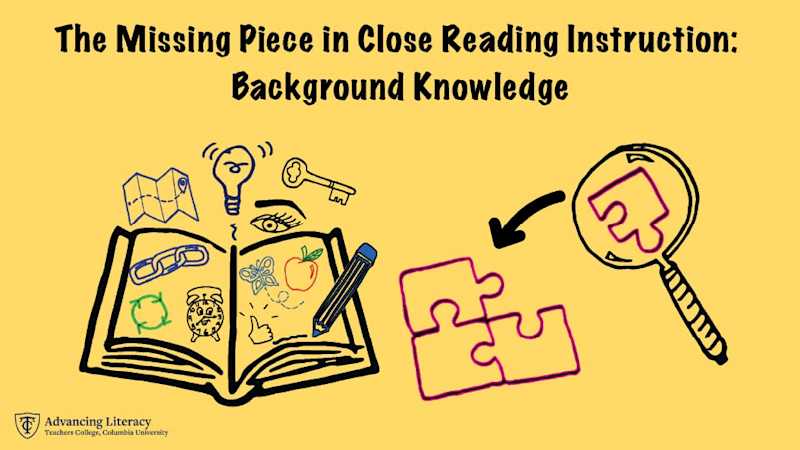
The Missing Piece in Close Reading Instruction: Background Knowledge
Published Monday, December 8, 2025
Advancing Literacy
Have you ever watched students work their way through a challenging text, dutifully annotating, underlining, and circling exactly as they've been taught, yet still struggle to grasp the main idea or deeper meaning? Leading to the big question—if kids are using the strategies that we’ve taught, what’s missing?
This post explores why close reading and knowledge building must work together and why the answer to this common problem of practice isn’t simply more strategy instruction. Let’s consider two classrooms that highlight this difference.
Knowledge and Close Reading in Action Imagine that the third graders in classroom A are studying famous American scientists. In one classroom, students lean over a passage about Mae Jemison's early science fair project, pencils poised to annotate. "Circle unfamiliar words," the teacher reminds them. "Underline the main idea." Students dutifully mark their texts, noting that Mae did a science project, worked in a lab, and won a prize. During discussion, responses remain surface-level. The teacher grows frustrated—they've practiced these annotation strategies all year.
Down the hall, in classroom B, before reading the same Mae Jemison passage, students have spent a few minutes building knowledge about barriers facing women in STEM during the 1970s, the significance of sickle cell anemia in African American communities, and the challenges of accessing professional research facilities as a teenager. Now, as they annotate, their pencils fly. Margin notes read: "She chose HER community's disease—personal!" and "A Black girl taken seriously in a lab in the 70s = rare." The discussion explodes with insights about breaking barriers, community-focused research, and validation.
While the passage selected for close reading in both classrooms was rigorous and engaging, the level of student engagement and learning outcomes were vastly different. This contrast illustrates what research has confirmed: background knowledge accounts for 30-40% of reading comprehension variance (Cervetti & Hiebert, 2015).
Why This Matters Close reading strategies—annotating, re-reading, asking text-dependent questions—are essential tools in our instructional repertoire. As Saccomano (2014) notes, "Close reading strategies help students read to uncover layers of meaning that lead to deep comprehension." However, Willingham (2006) also reminds us that comprehension strategies have limited impact without adequate knowledge.
Without background knowledge, students see only surface details: "Mae did a science project. She worked in a lab. The lab director helped Mae. She won the science fair." With appropriate context, the same passage becomes rich with meaning: "Mae chose to research a disease affecting her own community. She broke barriers by gaining access to a professional research lab as a teenager. An adult in STEM took Mae, a young Black woman, seriously, which was not typical in the 1970s."
The background knowledge students bring to the text helps them to use their reading strategies more meaningfully, supporting deeper comprehension.
Making Knowledge Building and Close Reading Work Together Fisher and Frey (2014) emphasize that close reading must be purposeful and tied to building understanding, not just skill practice. Thoughtful planning and instruction can help to make knowledge building and close reading mutually reinforcing practices.
Before the Lesson
Build systematic background knowledge across the year, not just immediately before reading
Select close reading texts with cross-curricular content connections in mind
Curate text sets rather than individual texts to develop knowledge progressively
Ask: “Do students have enough background knowledge to analyze this text deeply? What knowledge building needs to happen before this close reading lesson?”
Consider what type of knowledge students will need to build
Content Knowledge
Topic-specific facts
Historical context
Scientific concepts
Geographic information
Cultural background
Text Knowledge
Genre conventions
Text structure patterns
Literary/ rhetorical devices
Format or graphic features
Vocabulary
Tier 2 vocabulary
Domain-specific terms
Words with multiple meanings
Figurative languages
Connective language (thus, although)
World Knowledge
How systems work (e.g. governments, ecosystems)
Life experiences (family structures, religious conventions)
Social/ cultural norms
Current event connections
Essential Knowledge = Students CANNOT comprehend the text without it
Central concepts that the entire text depends on
Vocabulary that appears repeatedly or is crucial to meaning
Context is needed to understand the author’s perspective
Nice-to-Know = Enriches understanding but isn’t required
Interesting background details
Vocabulary that can be determined from context
As you plan your next close reading, consider these next steps:
Audit your text selections: Do they build knowledge cumulatively, or are they isolated readings?
Front-load strategically: What knowledge do students need to access the deeper meaning in your chosen texts?
Create text sets: Group texts thematically or by content area to develop expertise over time.
Observe with a knowledge lens: When students struggle with close reading, ask whether it's a strategy issue or a knowledge gap.
Think cross-curricularly: Select close reading texts that reinforce science, social studies, and other content areas.
Close reading and knowledge building aren't competing priorities, but instead are two vital aspects of purposeful instruction with complex texts. When we build students' background knowledge systematically and purposefully, we give them the foundation to engage in the deep, analytical thinking that close reading demands. The strategies matter, but they matter most when students have something meaningful to think about.
This post is based on content from "The Intersection of Knowledge Building and Close Reading," a presentation delivered by Molly Picardi and Kristin Smith at the October 2025 Teachers College Advancing Literacy conference for school and district leaders. To learn more about this and similar topics, explore our upcoming events.
References
Cervetti, Gina, and Elfrieda H. Hiebert.. “Knowledge, Literacy, and the Common Core.” Language Arts,. vol. 92, no. 4, Mar. 2015, pp. 256–69, https://doi.org/10.58680/la201526914.
Fisher, Douglas, and Nancy Frey.. “Close Reading as an Intervention for Struggling Middle School Readers.” Journal of Adolescent & Adult Literacy,. vol. 57, no. 5, 2014, pp. 367–76, https://doi.org/10.1002/jaal.266.
Saccomano, Doreen. . Texas Journal of Literacy Education.. Volume 2, no. Issue 2, 2014, pp. 140–47, https://files.eric.ed.gov/fulltext/EJ1110947.pdf.
Willingham, Daniel T.. How Knowledge Helps.. 18 July 2023, https://www.aft.org/ae/spring2006/willingham.